
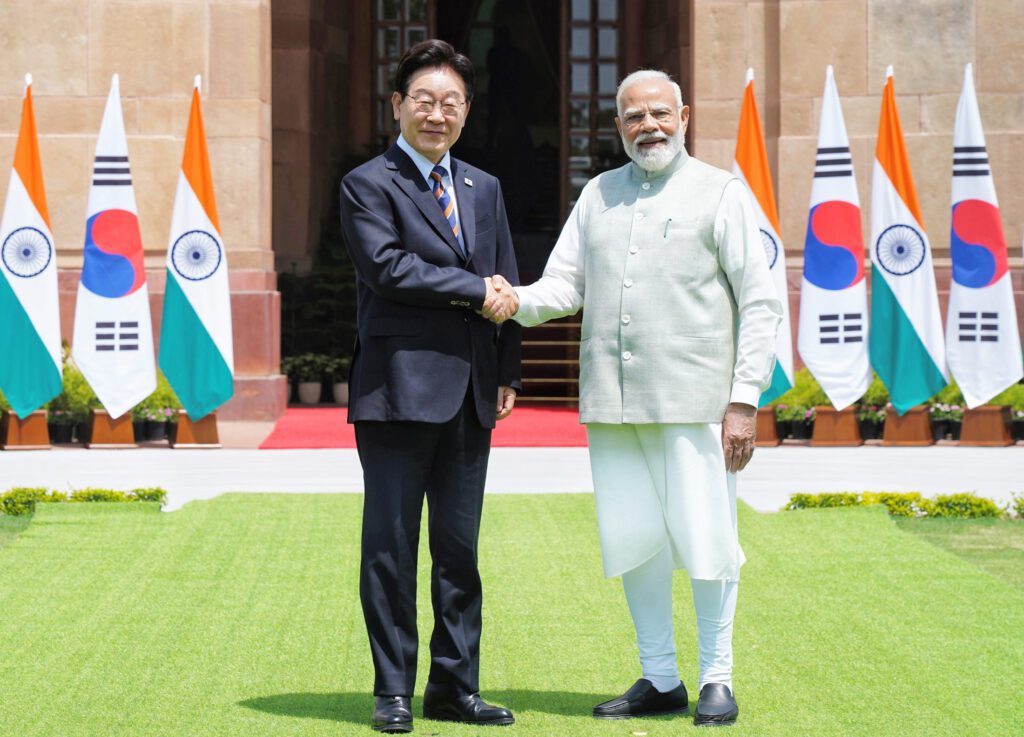
On 20 April 2026, a summit between South Korea and India was held in New Delhi. President Lee Jae-myung and Indian Prime Minister Narendra Modi reaffirmed their commitment to strengthening cooperation across the economy, industry, technology and supply chains, and adopted a Joint Strategic Vision alongside a number of cooperation agreements aimed at advancing the bilateral Special Strategic Partnership.
The two leaders agreed to expand cooperation across a wide range of sectors, including shipbuilding, maritime transport and logistics, artificial intelligence (AI), digital technologies, finance, defence, and cultural and people-to-people exchanges. In particular, they identified enhanced cooperation in strategic industries as a key priority.
In this explainer, Soojin Jang, Senior Account Executive – East Asia, examines the growing strategic industry cooperation between South Korea and India following the summit, with a particular focus on its implications for economic security, advanced technologies and defence cooperation.
Executive Summary
- South Korea and India have agreed to expand cooperation in strategic industries, includingdefence, semiconductors, criticalminerals and supply chain resilience, through the 2026–2030 Joint Strategic Vision, while strengthening their strategic partnership with a greater focus on economic security.
- The two countries are expanding the institutional foundations of their economic and trade cooperation through the resumption of negotiations to upgrade the Comprehensive Economic Partnership Agreement (CEPA), the establishment of the India–South KoreaIndustrial Cooperation Committee, and the launch of the Economic Security Dialogue.
- In thedefencesector, bilateral cooperation is deepening on the back of the successful K9 self-propelled howitzer programme, while cooperation in emerging technologies such as artificial intelligence (AI) and unmanned aerial vehicles (UAVs) is expected to expand through the proposed KIND-X initiative.
- For South Korean companies, opportunities in the Indian market are expected to grow across sectors such as semiconductors,defenceand digital technologies. For Indian companies, greater engagement with South Korean firms through technology partnerships and joint ventures could help strengthen manufacturing capabilities and participation in global supply chains.
The Significance of Expanding South Korea–India Strategic Industry Cooperation
Amid ongoing global supply chain reconfiguration and intensifying competition in advanced technologies, the importance of value chain restructuring and joint research and development (R&D) cooperation to strengthen supply chain security in strategic industries continues to grow. As a result, the strategic interests of South Korea and India are becoming increasingly aligned.
South Korea possesses strong technological capabilities in advanced manufacturing sectors such as semiconductors, defence and shipbuilding, while India is emerging as one of the world’s key growth markets and an important hub for global manufacturing and supply chain diversification. This complementary industrial structure provides a favourable foundation for expanding strategic industry cooperation between the two countries.
Through the summit, the two countries unveiled the 2026–2030 Joint Strategic Vision, which sets out the direction of bilateral cooperation over the next five years. Under the framework, both sides agreed to expand bilateral trade to approximately USD 50 billion by 2030 and deepen cooperation in strategic sectors including defence, critical minerals, semiconductors and supply chain resilience.
This demonstrates that bilateral relations are evolving beyond traditional economic, trade and investment cooperation towards a strategic partnership focused on strengthening economic security and industrial competitiveness.
CEPA Upgrade and the Expansion of the Economic and Trade Cooperation Framework
During the summit, the leaders of South Korea and India adopted a joint declaration to resume negotiations on upgrading the Comprehensive Economic Partnership Agreement (CEPA), which entered into force in 2010. The decision to restart negotiations is widely seen as reflecting the growing importance of economic security and the ongoing reconfiguration of global supply chains. In particular, persistent geopolitical uncertainty in the Middle East and rising supply chain risks have reinforced the need for South Korea and India to strengthen cooperation as partners in supply chain diversification.
The proposed CEPA upgrade can also be viewed as an effort to reflect changes in the global trading environment, extending beyond the expansion of trade in goods and services to encompass areas such as the digital economy, supply chain security and cooperation in emerging industries. As such, the resumption of negotiations is significant in that it represents an effort to develop a new framework for cooperation that goes beyond the traditional scope of a free trade agreement (FTA) to include economic security and industrial collaboration.
Furthermore, the two countries agreed to establish the India–South Korea Industrial Cooperation Committee to expand cooperation in strategic sectors, including semiconductors, shipbuilding, secondary batteries and strategic resource supply chains. They also agreed to launch an Economic Security Dialogue, creating an institutional framework for cooperation on economic security issues such as trade diversification, technology cooperation and strengthening the resilience of critical supply chains.
These developments demonstrate the strategic commitment of both countries to simultaneously strengthen economic security and industrial competitiveness.
KIND-X and the Deepening of Defence Cooperation
Following the South Korea–India summit, the two countries have been further operationalising defence cooperation through a series of high-level engagements.
On 20 May, South Korean Minister of National Defence Ahn Gyu-back and Indian Defence Minister Rajnath Singh held a bilateral meeting and agreed to expand defence and defence industry cooperation in line with the Joint Strategic Vision announced at the summit. Both sides spoke positively of existing defence cooperation achievements, including the K9 Vajra self-propelled howitzer programme, and agreed to continue expanding cooperation in the future. They also agreed to strengthen cooperation in defence cyber security and United Nations Peacekeeping Operations (PKO).
On the same day, Lee Yong-chul, Commissioner of South Korea’s Defence Acquisition Program Administration (DAPA), met with Defence Minister Rajnath Singh and agreed to further expand defence industry cooperation on the basis of the successful implementation of the K9 programme. The two sides also discussed the launch of the Korea–India Defense Innovation & Accelerator Ecosystem (KIND-X). KIND-X is intended to serve as a platform connecting defence companies, start-ups, universities and research institutions from both countries in order to promote cooperation in emerging technology fields such as artificial intelligence (AI) and unmanned aerial vehicles (UAVs). The initiative is expected to support joint research and development (R&D), technology cooperation and the identification of new business opportunities.
Such cooperation also aligns with India’s ongoing efforts to strengthen its domestic defence industrial ecosystem. The Indian government has been encouraging greater participation from private companies and start-ups in strategic industries, including defence. Alongside military modernisation, New Delhi has introduced measures aimed at simplifying defence procurement procedures, easing foreign direct investment (FDI) restrictions and expanding private-sector participation in defence research and development, with the broader objective of enhancing the competitiveness of its defence industry.
India remains one of the world’s second-largest arms importers while simultaneously pursuing defence industrial self-reliance as a national strategic priority. In this context, the technological capabilities and manufacturing expertise of South Korean defence companies, including those involved in the K9 programme, are well positioned to contribute to India’s defence modernisation and defence industrial development objectives. As a result, bilateral cooperation has the potential to expand beyond equipment exports towards joint production, technology cooperation and defence supply chain partnerships. This suggests that South Korea–India defence cooperation could evolve into a more institutionalised framework encompassing defence technology, cyber security and defence policy cooperation, rather than remaining focused solely on arms exports.
Implications for South Korean and Indian Businesses
For South Korean companies, India is becoming increasingly important not only as an export market but also as a production, sourcing and investment destination. Among the strategic industries highlighted during the summit, cooperation is expected to expand not only in the defence sector discussed above, but also in AI and semiconductors. Greater engagement by South Korean firms in the Indian market could also lead to broader science and technology cooperation, including joint research initiatives and talent exchanges, given India’s position as one of the world’s leading suppliers of IT talent.
From a manufacturing perspective, India’s Make in India initiative, Production Linked Incentive (PLI) scheme, India Semiconductor Mission (ISM) and Atmanirbhar Bharat strategy are all designed to strengthen domestic manufacturing capabilities. These initiatives are expected to create further opportunities for South Korean companies to expand their local presence and partnerships in strategic sectors such as semiconductors, defence, batteries and digital technologies. However, as local production requirements continue to strengthen, companies should carefully assess the scope and conditions of technology transfers, while also paying close attention to contract structures, pricing adjustment mechanisms and localisation requirements.
At the same time, the summit also presents opportunities for Indian companies to leverage South Korea’s advanced manufacturing capabilities and technological expertise.
South Korean firms possess extensive experience in managing global supply chains and maintain strong technological competitiveness across strategic sectors including semiconductors, defence, shipbuilding and digital technologies. This aligns closely with India’s efforts to upgrade its manufacturing base and strengthen industrial competitiveness. In particular, Indian companies may be able to enhance their production capabilities and technological expertise, while expanding access to international markets, through joint ventures (JVs), technology partnerships and research and development (R&D) collaboration with South Korean firms.
In addition, the expansion of economic security cooperation could create further opportunities for participation in global supply chains across strategic sectors, including critical minerals, semiconductors, batteries and defence-related supply chains. The semiconductor sector provides a particularly strong example of the complementary nature of South Korea–India cooperation. In May 2026, the Indian government approved two new semiconductor projects worth approximately USD 414 million as part of its continued efforts to develop the country’s semiconductor industry. The projects focus on expanding capabilities in semiconductor packaging (OSAT/ATMP) and compound semiconductor manufacturing and are expected to accelerate the development of India’s semiconductor ecosystem.
However, India’s semiconductor industry remains at an early stage of development. Building a self-sufficient semiconductor supply chain comparable to those of South Korea or Taiwan is likely to face structural constraints in areas such as manufacturing expertise, skilled labour and industrial ecosystem development. In this context, South Korea represents a valuable partner given its advanced manufacturing capabilities and experience in managing global supply chains. Bilateral technology cooperation and joint R&D partnerships could therefore support India’s efforts to strengthen semiconductor manufacturing capabilities and expand participation in global value chains (GVCs).
If you would like to learn more about the implications for your business, please contact us at hello@northstar-insights.com