
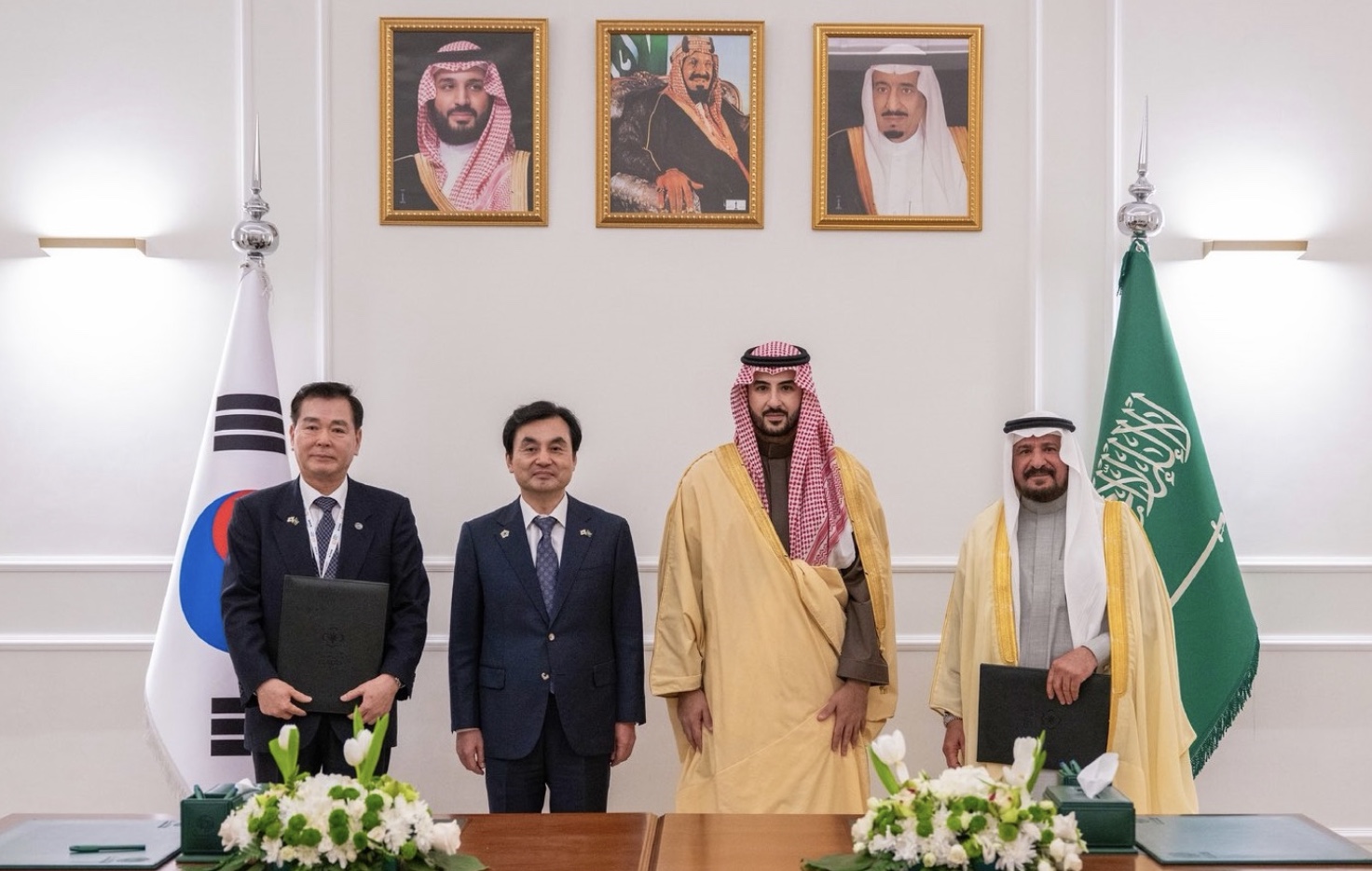
In this explainer, Soojin Jang, Senior Account Executive – East Asia, examines the evolving defence relationship between South Korea and Saudi Arabia. Situated in one of the world’s most volatile regions, Saudi Arabia has made national security a cornerstone of Vision 2030 and its deepening partnership with Seoul reflects that priority. The recent high-level engagement signals a shift from transactional arms exports toward joint R&D financing and co-development, underscoring both South Korea’s expanding global defence posture under President Lee and Saudi Arabia’s broader push for strategic diversification.
Executive Summary:
- South Korea and Saudi Arabia discussed expanding bilateral defence cooperation during a meeting held on the sidelines of the World Defence Show (WDS) in Riyadh in early February.
- The meeting signalled a shift in cooperation from a model focused primarily on arms exports towards broader collaboration in defence research, development, and technology.
- Saudi Arabia’s defence industrial strategy under Vision 2030, including efforts to increase local production in the defence sector, is creating greater opportunities for industrial cooperation with foreign defence companies.
- South Korean defence firms, including Hanwha Group affiliates, are expanding their presence in the Middle East through regional headquarters and industrial partnerships.
- Such cooperation may contribute to strengthening defence industrial collaboration between South Korea and Saudi Arabia and expanding defence industry engagement in the Middle East.
As the war between the United States and Iran spreads across the Middle East, interest in South Korean weapons systems in the regional market, including Korea’s medium-range surface-to-air missile systems, the K9 self-propelled howitzer, and the K2 main battle tank, has been increasing. As security uncertainty in the Middle East grows, demand for military modernisation among regional states is also rising. In this context, there are growing assessments that South Korea’s defence industry may encounter new opportunities in the Middle Eastern market.
Against this backdrop, it is noteworthy that discussions on expanding defence cooperation between South Korea and Saudi Arabia had already taken place in early February. On 8 February, South Korean Defense Minister Ahn Kyu-baek visited Saudi Arabia to attend the third World Defence Show (WDS) held in Riyadh, where he held talks with Saudi Defense Minister Khalid bin Salman Al Saud. During the meeting, the two sides agreed to further develop mutually beneficial defence and defence industrial cooperation. South Korea also pledged to strengthen the promotion of K-defence exports and to provide national level support to help small and medium sized enterprises enter overseas defence markets, reaffirming both countries’ commitment to expanding bilateral defence cooperation.
In particular, the meeting outlined a shift in bilateral cooperation from a model centred primarily on arms exports towards broader defence collaboration focused on research and development (R&D) and technological cooperation. The two sides signed a memorandum of understanding (MoU) on defence R&D cooperation and agreed to establish a long term partnership that includes the development of network based weapons systems and collaboration in defence technologies. Saudi Arabia is also expected to benefit from South Korea’s advanced defence technologies and industrial experience in strengthening its own defence capabilities. In this respect, the meeting demonstrates how South Korea’s defence cooperation strategy is evolving from simple arms transactions towards long term technological collaboration.
Saudi Arabia is one of the largest defence markets in the Middle East and a major purchaser of South Korean weapons. South Korean defence companies have already supplied a wide range of weapons systems to Saudi Arabia, including aircraft, missile systems, and combat vehicles. However, the significance of this cooperation lies not only in the export of defence products but also in the potential to enhance global competitiveness in the defence sector through joint research and industrial collaboration between South Korean and Saudi firms. Expanded cooperation between companies in both countries is also expected to contribute to strengthening local industrial capacity and creating employment opportunities.
The Saudi government is currently pursuing large scale defence projects aimed at developing its domestic defence industry and modernising ground equipment, while actively promoting policies to strengthen national defence industrial capabilities. In particular, Saudi Arabia is advancing policies to increase the local production ratio in the defence sector over 50 percent, making industrial cooperation with foreign defence companies increasingly important.
Within this market environment, South Korean defence firms are also expanding their presence in the Middle East. Notably, Hanwha Aerospace established its Middle East and North Africa (MENA) regional headquarters in Riyadh last year. This regional hub facilitates cooperation not only within Hanwha Aerospace but also among other defence affiliates of the Hanwha Group, including Hanwha Ocean and Hanwha Systems, enabling broader industrial collaboration to respond to Saudi Arabia’s defence demand.
Indeed, following the bilateral meeting, Hanwha Ocean further expanded defence cooperation by signing an agreement to support the Saudi Navy. This initiative is seen as aligning South Korean companies’ supply chain development and production capabilities with the Saudi government’s defence localisation strategy. Hanwha Ocean is focusing on combining its global naval shipbuilding expertise with the engineering, procurement, and construction (EPC) capabilities of the local Petroleum Vision Contracting Company Petro-V. Through this collaboration, localisation within Saudi Arabia’s defence ecosystem and the expansion of supply chains are expected to be further strengthened.
As demand for defence technologies and military modernisation continues to expand across the Middle East, the Saudi government is actively pursuing greater defence self reliance and industrial capacity under its Vision 2030 strategy. Within this policy framework, cooperation with South Korean firms is expected to contribute to expanding the participation of Saudi companies and strengthening domestic defence manufacturing capabilities. South Korea’s localisation cooperation model is regarded as a mutually beneficial approach. It strengthens Saudi Arabia’s defence self reliance while enabling South Korea to secure production and maintenance hubs that can serve the wider Middle Eastern region. Such cooperation may therefore carry broader strategic significance not only for bilateral industrial collaboration but also for the development of a new defence cooperation network linking Asia and the Middle East.
If you would like to learn more about the implications for your business, please contact us at ceo@northstar-insights.com