
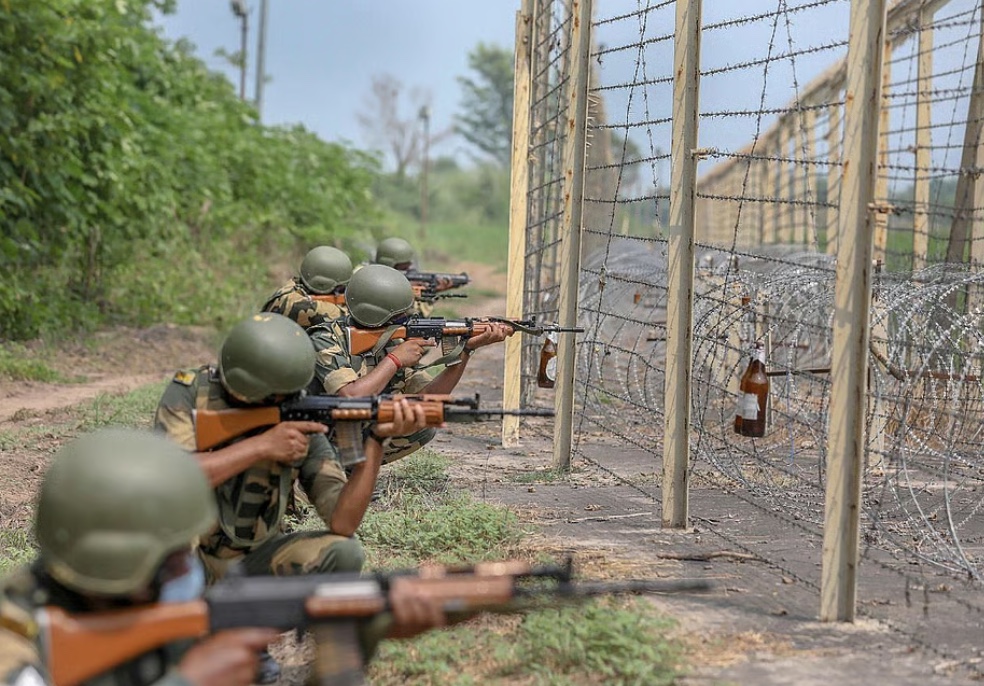
In this explainer piece, South Asia Analyst Bandish Oza explores India’s decisive pivot toward a multi-domain security architecture along its eastern frontier, specifically targeting the vulnerabilities of the Siliguri Corridor. Drawing on recent strategic shifts, Oza examines how New Delhi is moving beyond its traditional “defensive-only” posture to counter a nascent “three-front dilemma” involving the growing alignment between Dhaka, Islamabad, and Beijing.
Executive Summary:
- India has established three new military garrisons in Bamuni, Kishanganj, and Chopra to secure the Siliguri Corridor, transitioning from passive deterrence to a posture of regional dominance through multi-layered air defense, missile regiments, and rapid-response drone units.
- This military buildup is a direct response to shifting geopolitics, specifically the warming ties between Bangladesh, Pakistan, and China, highlighted by the reopening of the China-backed Lalmonirhat airbase near the Indian border and increased naval cooperation between Dhaka and Islamabad.
- For investors and multinationals, the increased militarization introduces a higher risk premium for cross-border infrastructure and trade, signaling a critical need for supply chain diversification while simultaneously opening high-growth opportunities in the defense-tech and security sectors.
The Geostrategic Significance
The Siliguri Corridor is not just geography but a lifeline to the northeastern states of India nestled between Bangladesh, Nepal, Bhutan and China. By reinforcing it with new garrisons, India is dramatically boosting rapid-response capabilities, surveillance and ground mobility.
To protect this choke point, India is also deploying multiple layers of defence:
- Air defence: S-400, MRSAM (DRDO + Israel) and Akash;
- Strike potential: BrahMos missile regiments, Rafale jets at Hashimara Airbase;
- Quick forces: Ashni drone platoons and Bhairav battalions to target and destroy.
This is not mere deterrence. Military analysts say India is shifting to a posture of dominance across its eastern theatre.
The Regional Backdrop: Dhaka, Islamabad and Beijing
This military formation is accompanied by a significant shift in regional geopolitics. Bangladesh is reportedly strengthening its relationship with Pakistan and China, which is a cause of concern for New Delhi. Muhammad Yunus-led Bangladesh has repeatedly hosted Pakistani leaders – both political as well as military. Bangladesh hosted the first Pakistani naval ship after 50 years, signalling the growing security ties between Dhaka and Islamabad.Complimentary to this, China is reopening a World War II airbase in Lalmonirhat, Bangladesh, only 12-15 km away on the Indian border. This airbase is reportedly capable of both civilian as well as military use. This signals a wider strategy of encirclement wherein China extends its influence deep into India’s periphery, particularly in areas around a vital strategic bottleneck.
India seems to have adopted a calibrated approach by fortifying Chicken’s Neck. Rather than reacting impulsively, it is reinforcing its eastern flank in a disciplined multi-domain fashion.
What This Means for Business Risk
- Trade and Connectivity Risk: Increased militarisation would put cross-border trade routes at risk and reprice logistics risk. Companies that rely on trade via Bangladesh or Northeast India can experience rising costs and/or mounting risk.
- FDI & Infrastructure: Higher the security tension, higher the risk premium in cross-border infrastructure projects. Rail, road, or energy investors connecting India and Bangladesh should observe political developments carefully.
- Supply Chain Diversification: For multinationals, India’s eastern region is becoming a double-edged sword: strategically valuable, but politically sensitive. Diversifying supply chains or logistics routes may no longer be optional.
- Defence and Security Sector Opportunities: India’s expansion could boost demand of advanced defence systems, from missile defence to drones. For investors in the defence-tech space, this shift amplifies growth potential.
A New Security Architecture
Growing Indian military footprint in the Northeast signals a transition to a layered deterrence approach, consisting of ground forces, air capabilities and speedy precision forces to establish a multi-tiered security grid. These new installations are not isolated outposts; they are embedded within a broader logistics and transport ecosystem, enhancing mobilisation capacity and strengthening supply chain resilience across the region. Contextualising these developments with the reviving of Bangladesh-Pakistan ties presents an indicator of more than a defensive shield to the Northeast. It represents a forward-leaning posture aimed at projecting power and disincentivising more profound strategic orientation between Dhaka, Islamabad and Beijing.
Indian reinforcement of the Siliguri Corridor is not just a military exercise but also a geopolitical message and a realignment of its own security system to the east. Weaning resources off its historically volatile North-Western frontier to build a defensive line to the East is indicative of the changing winds in South Asian security landscape. For businesses and investors, it introduces a new layer of geopolitical risk, but also signals where Indian strategic priorities lie. If trade corridors, connectivity and investment round out India’s future, then the Chicken’s Neck may become a key battleground in shaping that future.
If you would like to learn more about what this means for your business, please contact us at ceo@northstar-insights.com