
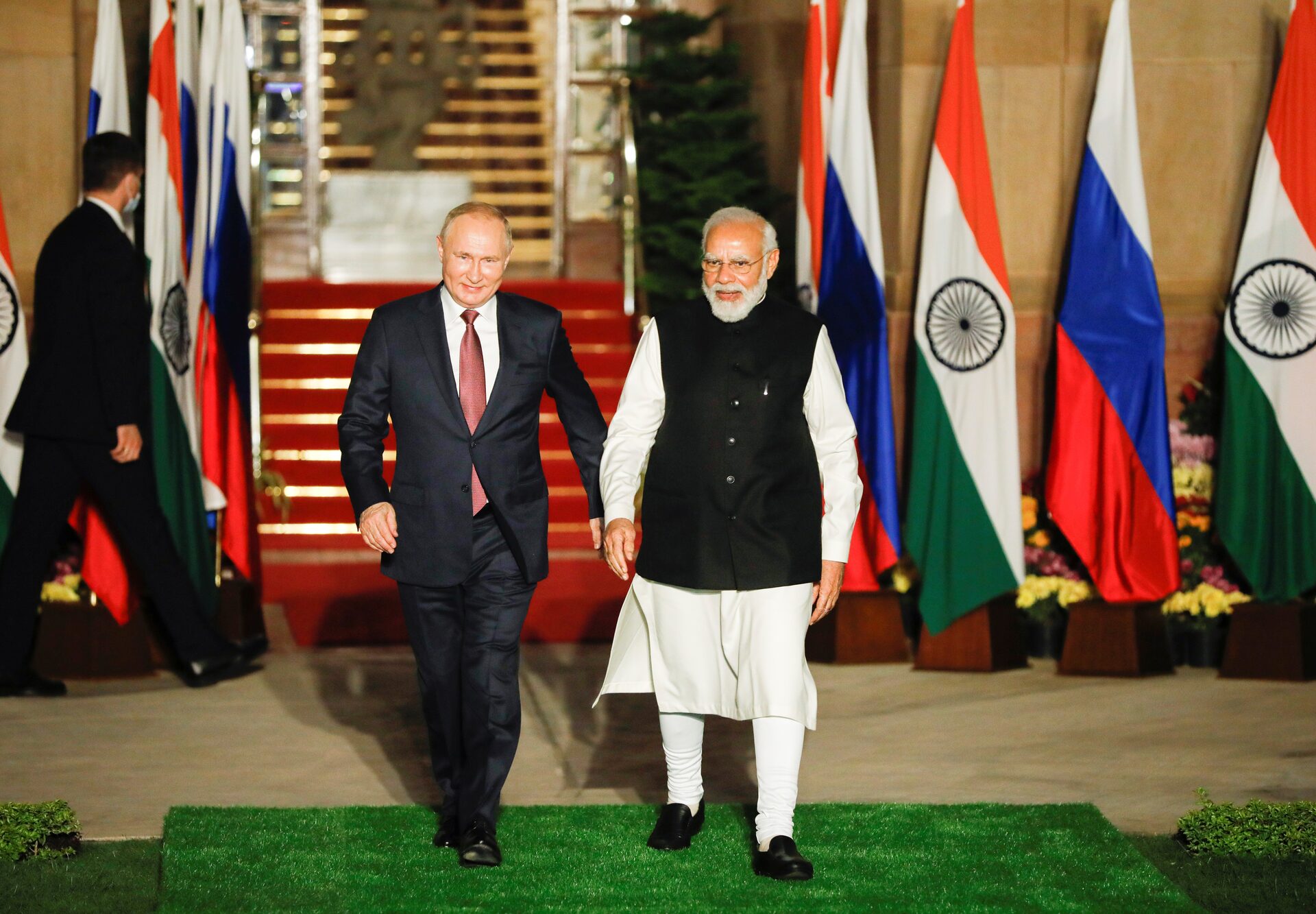
In this strategic explainer, South Asia Analyst Bandish breaks down the outcomes of the 2026 Delhi Summit between India and Russia. The analysis examines the transition from a legacy defense relationship to a sanctions-aware economic partnership, anchored by a $100 billion trade goal. It explores how India is navigating a “dual-track” strategy that is maintaining deep ties with the West while asserting economic autonomy through a 2030 roadmap focused on energy security, industrial co-development, and diversified trade.
Executive Summary:
- The summit codified a shift beyond crude oil and defense, targeting $100 billion in annual bilateral trade by 2030. This creates a political “green light” for Indian firms in pharma, FMCG, and IT to fill voids in the Russian market, while utilising the International North-South Transport Corridor (INSTC) to de-risk logistics.
- While Moscow pledged “uninterrupted shipments,” New Delhi signaled a cautious, business-first approach. Future energy ties—encompassing discounted crude, LNG, and nuclear fuel—will be weighed strictly against the commercial risks of Western secondary sanctions, moving away from a stable long-term anchor toward a more volatile, opportunistic channel.
- Business activity will increasingly operate under a “sanctions shadow,” likely utilising rupee, dirham, or third-currency payment structures. For global stakeholders, this asserts India’s intent to maintain a distinct Russia channel, requiring rigorous legal controls for companies operating within India’s complex “West+Russia” ecosystem.
India’s latest summit with President Putin in Delhi marked a decisive shift in the India–Russia relationship from legacy defence ties towards a more complex, sanctions-aware economic partnership. Rather than big-bang arms deals, the visit was framed around a 2030 economic roadmap, energy reassurance and new labour and sectoral linkages that matter directly for businesses operating in or with India. Below are the four major takeaways from the visit, and their implications on businesses.
- A 2030 Roadmap and the $100 Billion Trade Goal
At the core of Putin’s visit was the programme for the development of strategic areas of India–Russia Economic Cooperation until 2030, which will boost bilateral trade up to approximately $100 billion per year by 2030. The roadmap explicitly pushes both parties to diversify beyond crude oil and defence by expanding cooperation into fertilizer and agriculture (Russia has made a commitment of supplying 5-5.5 million tons of fertilizer to India in 2025), pharmaceuticals, health and medical technology, and shipping and logistics through the International North-South Transport Corridor. To Indian companies, this provides them with a relatively easier political accommodation to expand into sanctioned but still accessible Russian markets, particularly in pharma, FMCG, IT services, machinery and construction. But, to foreign investors it is an indication that India intends to keep a distinct Russia channel open even as it courts the US and EU.
- Energy: Reassurance from Moscow, Caution from Delhi
On energy, Putin pledged “uninterrupted shipments” of fuel. Taking continued US purchase of Russian nuclear fuel as an example, he argued that India should not be stigmatised for purchase of oil. India was however very cautious in tone. Russian oil shipments to India already decreased in 2025 because the US secondary tariffs on its exports have increased the political and commercial cost of deepening energy ties. New Delhi signalled that future purchases will be seen purely as business decisions, balancing discounts against sanctions and tariff risks. To corporates, it means Russia will continue to play in the Indian energy mix, especially for discounted crude and potentially more LNG and nuclear fuel, but not at any price. Moreover, downstream players such as refiners, shippers and insurers will have to deal with a volatile, politically exposed Russian channel as opposed to a stable long-term anchor.
- Defence: From Buyer–Seller to “Make in India” Sustainment
In defence, the summit secretly made the relationship less that of buyer-seller to that of Make in India sustainment and co development. The two nations have decided to focus on joint R&D and production of high-tech systems in India, local production of spares and components of the already existing Russian platforms, which opens opportunities for Indian defence industries, MSME suppliers of components, as well as localisation of Russian-based systems through licensed production. Western suppliers can expect continued competition from Russian designs embedded in India’s Atmanirbhar Bharat supply chains, even if the flow of new pure imports from Russia slows. For global defence OEMs, the key message is that Russia is evolving into a technology partner and IP contributor within Indian industrial policy constraints rather than exiting the market.
- Sanctions Shadow and Risk Management for Businesses
All this unfolded under a dense sanctions overhang. The presence of senior executives from Rosneft, Gazprom Neft, Sberbank and Rosoboronexport shows Russian expectation of using India to access equipment and finance structures otherwise rendered inaccessible due to Western sanctions, even as New Delhi courts Washington for a trade deal. For businesses, the message is that India is deepening economic channels with Russia in an assertion of economic autonomy. At the same time, it is also attempting to manage sanctions risk, meaning that most India-Russia deals will likely run through rupee, dirham or other third-currency structures.
In short, Putin’s visit did not revive an old Cold War partnership; it codified a new, business centric one, anchored in a 2030 trade roadmap, selective energy ties and labour and industrial cooperation, under the constant constraint of sanctions and great power competition. Companies that can work within this dualtrack India (West+Russia) strategy, with rigorous legal and sanctions risk controls, stand to benefit most.
If you would like to learn more about what this means for your business, please contact us at ceo@northstar-insights.com